AU earning high praise from students for becoming sixth PA school in the country to adopt Healer’s Art Course
ASHLAND, Ohio – When Ashland University’s latest class of physician assistant students crossed the Hugo Young Theatre stage in August to receive their Master of Science in Physician Assistant degrees, they did so not only having acquired a first-rate medical education and clinical experience, but with additional innovative skill training that will ultimately benefit the patients they care for.
Each member of a physician assistant cohort is now required to participate in the Art of Medicine’s Healer’s Art Course during their clinical year, which makes AU just the sixth PA school out of more than 300 nationally to integrate the program into the curriculum. The course has become fairly common for medical schools, with about 90 now offering it, but rare for PA programs.
The goal, according to Melissa Irwin, director of AU’s PA program, is for students to develop the interpersonal skills necessary to clearly and effectively interact with patients and their families in what can often be challenging situations.
“Professionalism has always been one of the most essential elements in shaping a physician assistant. This course allows students to step beyond medical content and focus on the professional and personal skills necessary to become a compassionate, competent provider at the bedside,” said Irwin.
The objectives of the Healer’s Art Course complement the patient-centered care, cultural humility and team approach components of AU’s PA program mission, as well as the ICARE values of the Dwight Schar College of Nursing and Health Sciences. So, it was an easy decision to adopt it in to the curriculum.
“We place a strong emphasis on preventing burnout, fostering empathy and upholding the ethical dimensions of medical practice,” explained Irwin. “(The Healer’s Art Course) embodies the mission and values of the college, demonstrating both a clear alignment and a meaningful need for its integration into our curriculum.”
What is the Healer’s Art Course?
The Healer’s Art Course was originally designed by Rachel Remen, M.D., an internationally-known medical educator and pioneer of the integrative medicine movement, and in a June 2022 report, it was specifically cited by former U.S. Surgeon General Vivek Murthy as an example of a program that supports learner well-being.
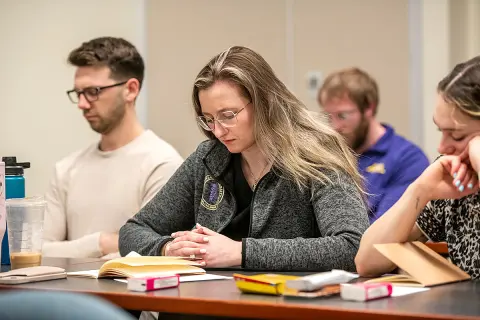
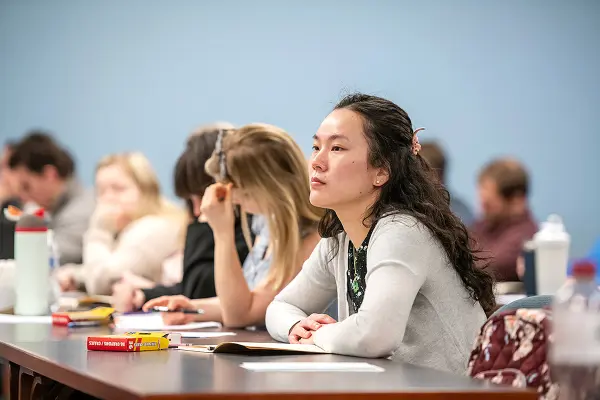
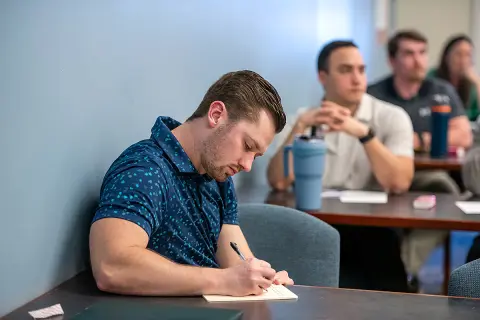
The course is a series of five workshops that are based on the discovery model, meaning the students are the active drivers of their learning. They intentionally reflect on various thought-provoking exercises to gain a deeper understanding of themselves and their experiences, then go further with journaling and small group discussion. Altogether, it will help them connect more fully with future patients and improve their analytical and problem-solving skills as a practitioner.
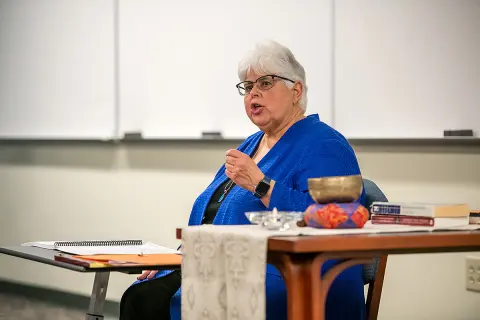
The workshops at AU during the spring semester were led by Evangeline Andarsio, M.D., clinical associate professor at Wright State University Boonshoft School of Medicine. Andarsio trained with Remen and is now director of the Remen Institute for the Study of Health and Illness.
There are four pillars of the Healer’s Art Course that Andarsio hopes each student builds upon: the importance of professional identity formation, resiliency, addressing healing relationships and building supportive communities.
“They’re exactly what medicine needs right now … that’s what we hope that they find in this course, that they are enough,” Andarsio said of the students. “And, with the excellent education here at (Ashland University), in this PA school, and who they are as people that they make a difference into the future care of their patients and in the healthcare system.”
Benefits are two-fold
Irwin emphasizes that the Healer’s Art Course ultimately benefits both the patient (plus their loved ones) and the PA’s themselves. By establishing an authentic relationship and being more mindful of a patient’s emotions, a provider can dig deeper and determine a more accurate diagnosis and treatment plan.
“I tell students, ‘you have to unpack a patient’s backpack,’” she explained. “In the program, we teach how to work up a chief complaint, order diagnostic studies, interpret results and create a therapeutic plan. But we also remind students to unpack everything else a patient carries with them. Treat the disease, yes, but always remember the goal is to treat the person, the human being. I think this curriculum really helps reframe that perspective.”
The course also addresses the burnout rate, fatigue and mental health issues that have increased recently in the healthcare industry. It helps remind PA students and other health professionals of their “why,” and it gives them techniques to practice for when they’re faced with a difficult situation.
“When you look at the research and the burnout rates among PA’s in practice, the question becomes ‘how do we best equip our students to truly enjoy the profession they’ve worked so hard to enter,’” said Irwin. “These students have worked tirelessly to earn their place and complete the program, and we want to ensure they continue to find meaning and fulfillment in the profession they've chosen.”
Early returns are in
Based on the response of the 2025 graduates, the first at AU to experience the Healer’s Art Course, it will become an integral part of the program moving forward. As second-year PA students, they were able to apply some of the lessons learned during the workshops to their clinical rotations when they were seeing patients daily.
Bethany Graham, of Elyria, Ohio, thought the new skills and reinforcement of others led to improved confidence and a more fully-developed set of competencies than other young providers, while also noting that the course differentiated AU from other PA schools.
“Many of our preceptors in clinical year had great things to say about us and some even stated wanting to hire us,” said Graham. “This recognition has been brought about in part by the Healer’s Art Course, which has strengthened our self-awareness, resiliency and the ability to connect with our future patients, particularly to see and treat these individuals as inherently valuable beings.”
Having the opportunity to complement her detailed medical book work and clinical experiences with some focus on the humanity aspect of medicine, was especially valuable for Alyssa Burley from Fraser, Michigan.
“As we spent two years diving into diagnostics and treatment, there wasn’t a time we talked about the emotional support required to be a provider … until we completed the Healer’s Art Course,” said Burley, an exercise physiologist before joining the PA program. “The course taught us to be mindful. From patients’ emotions to their support system, there is more to medicine than treatments and diagnostics.”
That’s exactly the point—there are healing qualities, in addition to medicine, that physician assistants can bring to their patients and families—Irwin hoped to get across to AU PA students when she ushered in the program.
“We took a step back and asked, ‘What do we want an Ashland University PA program graduate to embody,’” she said. “Our vision is rooted in the mission and values of the program, developing compassionate, competent providers who serve their communities with integrity. We’re intentionally moving to prioritize empathy, connection and well-being of training the next generation of PAs. Even as a young program, we’re continually advancing toward the kind of excellence we envision for our graduates and the PA profession.”