AU professor’s book a finalist for 2025 George Washington Prize
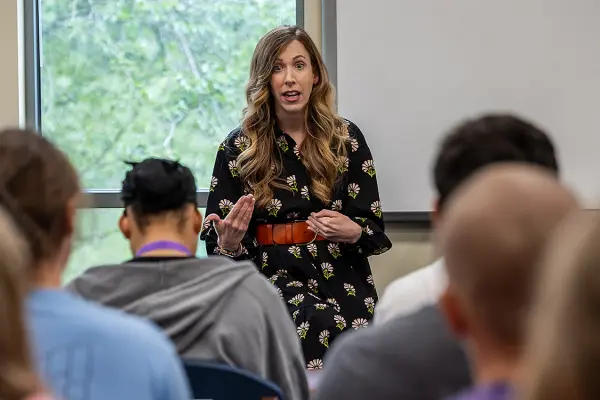
ASHLAND, Ohio – A groundbreaking book authored by Cara Rogers Stevens, Ph.D., associate professor of history at Ashland University, has been named as one of five finalists for the 2025 George Washington Prize, one of the nation’s most notable literary awards.
Stevens’ work, “Thomas Jefferson and the Fight Against Slavery,” analyzes a book by Jefferson, “Notes on the State of Virginia,” and helps to clarify one of America’s Founding Father’s true views on slavery among other subject matter.
“Notes on the State of Virginia,” written in the 1780s, had been used as a political weapon by both pro- and anti-slavery forces during the early 19th century. Stevens sought to research Jefferson’s composition in an effort to address the perplexing topic of “how the guy who wrote the Declaration of Independence could also have slaves” she succinctly put it.
Lindsay Chervinsky, executive director of the George Washington Presidential Library, stated, “The finalists are the best of rigorous and thoughtful history, written with delightful prose, compelling storytelling and an eye to why history matters today. These books give us a better understanding of the founding era and our current moment, as only the best history can do.”
Stevens, who has been a faculty member in the history and political science department at AU since 2018, described being a finalist for the prestigious George Washington Prize as “one of the highest honors I could hope for.”
“Thomas Jefferson and the Fight Against Slavery” has already received a number of accolades. It won the Herbert J. Storing Book Prize, which recognizes books that focus on the ideas of the American Founders, was a finalist for the Center for Presidential History Book Prize and runner-up for the Journal of the American Revolution Book of the Year Award.
Among the reasons “Thomas Jefferson and the Fight Against Slavery” has been critically acclaimed, it uncovered new material on one of America’s most fascinating and controversial figures. Previous researchers had used a microfilmed version of “Notes on the State of Virginia,” but in 1997, the manuscript was taken apart and digitized properly, according to Stevens, so that all of Jefferson’s changes and revisions became clear.
“I’m one of the first scholars able to look at that complete manuscript of Jefferson’s book and track the changes he made over time,” Stevens explained. “That’s one of the most exciting parts of my research. I think we’ve learned new things about Jefferson’s commitment to anti-slavery by studying the manuscript in this completely accessible, digitized form.”

Stevens’ book began as a dissertation in 2011 when she was a graduate student at Rice University as well as a personal quest. An immigrant to the United States, she was inspired by the words of the Declaration of Independence, but eventually became deeply conflicted by the historical document’s primary writer and wanted to more fully understand him.
“Freedom and equality are very important to my family and myself,” said Stevens, who was born and raised in South Africa. “That’s why the Declaration has such a special resonance for me. (It’s) why I admire the American experiment in self-government and in attempting to be a melting pot for people of all different races and colors and ethnicities.”
On the other hand, she added, “By the time I got to graduate school, I was really troubled by the fact that the man who wrote such an inclusive statement of human equality could also have owned human beings. I wanted to find out how is that possible. Was Thomas Jefferson a hypocrite, or is there more to the story? Is there more information in history that can help us understand him better? So, I did this research project as a way of trying to understand the Declaration of Independence better.”
Twelve years and countless revisions later, Stevens not only is the celebrated author of an award-winning book but she also was able to authenticate satisfactory answers to her concerns.
“It was very helpful … because I discovered Thomas Jefferson genuinely did oppose slavery and that he genuinely did quite a few things to try to end slavery. He tried to get several different laws passed, and in his own personal life, he had a plan to free his slaves that did not work out,” she said.
Stevens continued, “Some of what I was able to uncover was new information. That was a great surprise because when you’re writing about someone like Thomas Jefferson, you think someone else must have said everything there is to say … about somebody like this man. But, it’s not true. There are still new things that people can uncover if they are asking the right questions and reading the right sources.”
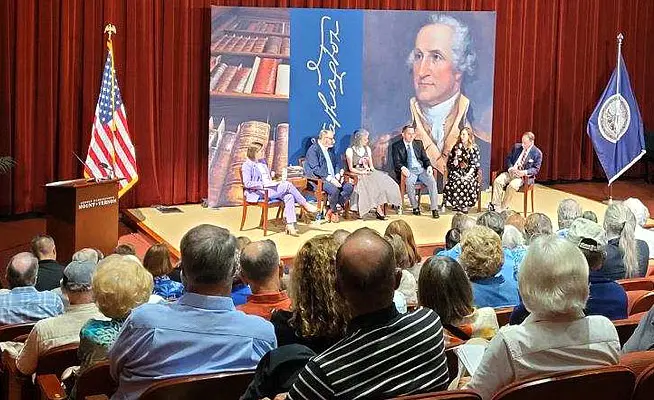
The winner of the George Washington Prize will be announced at a gala dinner in New York City on Oct. 8. Stevens and the other four finalists were at Mount Vernon Aug. 12, discussing each of their works during a panel conversation.
Created in 2005 to recognize outstanding examples of robust and thought-provoking explorations of America’s unique history, the George Washington Prize is sponsored by Mount Vernon, the estate of George Washington; the Gilder Lehrman Institute of American History, a leading nonprofit organization dedicated to K-12 history education; and Washington College.