
Blog: The AI skills gap is not technical. It is managerial.
Why the future of AI at work depends less on knowing how to prompt and more on knowing how to judge
Before we can determine whether the output of an AI system is acceptable or not, it has to have produced something. AI systems can create an enormous amount of work in a very short space of time, so a report, analysis of data, training scenario, summary of research, possible solution to a problem or even complete presentations can all be generated by an AI system in the time it takes to make a cup of coffee and read the newspaper.
But is the output good?
The real unknown as AI becomes more pervasive in work is whether managers will be able to judge AI-generated work. A frequently discussed topic when it comes to the ‘AI skills gap’ is whether employees have the right technical skills to use AI. There is a lot of investment in tools, prompts, automation and ways to incorporate generative AI into existing processes and workflows. However, in addition to these technical skills, there is another critical skillset that may be in short supply, which has significant implications for work and for the types of jobs that will be required in the future.
A significant amount of attention has focused on the need for employees to have analytical thinking skills. Other skills that are highly sought after by employers include those that allow individuals to be resilient, flexible and agile in their work as well as exhibiting leadership and social influence skills (World Economic Forum, 2025). This combination suggests that organizations need more than technological capability.
Another skill gap that is looming large for organizations.
Can managers tell good AI-generated work from bad?
The ability to generate an answer and the ability to judge the quality of that answer are two very different skills.
AI Is Moving from Tool to Team Member. This distinction matters because our relationship with artificial intelligence is changing. In addition to simple writing tasks like producing email or coming up with ideas for a report, organizations are now using AI to do research, financial analysis, customer service, project planning, training, data analysis, etc. to name a few.
Microsoft’s 2025 Work Trend Index describes an emerging workplace structure as one where humans work in teams with AI agents. Microsoft introduces the term “agent boss,” i.e. the human who builds an AI agent, then delegates to it and manages it.
In five years time, 51% of managers expect to be training and managing other teams in AI agents, according to the report (Microsoft, 2025). That represents an important shift. Much of the focus around the AI skills gap has focused on whether employees have the right technical skills to use AI, for example, how to use prompt engineering and how to automate processes using AI. Many organizations are investing heavily in these skills as well as the AI tools themselves to support the increasing use of generative AI within workflows. It’s however also important to recognize that whilst employees may develop the skills to use AI, there will be another set of skills that are required to manage and evaluate the work of AI.
Can managers and employees develop the skills to establish clear expectations of AI-generated work, evaluate its quality, identify any issues or defects and sign off the work as complete and fit for purpose?
There’s more to managing others who are working with AI than being able to use the technology themselves. They need people who can manage AI-assisted work.
When the Output Looks Better Than It Performs
This is a problem that I have been grappling with in my own work recently. In addition to teaching, I work as a Curriculum Course Manager for training for the U.S. military. Our instructors are subject matter experts for the content on Command and Control systems for operational scenarios. As a member of the curriculum team for the development of our training, my specialty is writing, structuring and delivering content to meet the standards for military training and education. That distinction has become particularly interesting as AI enters the curriculum development process. The AI-generated training material appeared to be excellent upon initial review. It was well organized and had appropriate language and content for the scenario “Master Scenario Event List” (MSELs) example.
Then we ran the MSELs. That was where the gaps became visible. While the training materials generated by AI looked good on the page (organized, professionally written, complete scenarios, etc.), they did not perform as expected when actually used for the training. This revealed gaps in the AI-generated content. That same principle applies so much more than writing curriculum! The most dangerous AI output may not be the obviously wrong answer, but the answer that looks right.
We may be misdiagnosing the AI skills gap as technical
AI literacy is important to develop for employees and for managers to become proficient in using various AI tools responsibly. But technical proficiency is not the same as managerial judgment. Being able to prompt an AI system to generate answers to questions is not the same as being able to spot a flawed analysis.
It is possible to be very proficient at using AI while being very bad at managing it
A manager does not necessarily need to have full understanding of all the underlying technical details of a large language model to recognize a number of things about a recommendation or answer produced by it, including that it lacks evidence to support its claims, ignores key constraints or is just plain nonsensical in the organizational context. Only a handful of skills are increasing faster in demand than AI and big data, namely analytical thinking followed by leadership, systems thinking, creative thinking and other human-centered skills. It is these skills that are at the core of how organizations will function as more and more aspects of employment are mediated through technology (World Economic Forum, 2025).
This suggests that we need a broader definition of AI readiness. Note that my own views on what constitutes responsible use of AI by managers are embodied in the five actions below. These reflect my experiences as well as emerging research on human-AI collaboration and oversight of AI.

The combination of FRAME, DELEGATE, EVALUATE, VERIFY and DECIDE effectively covers the necessary actions that a manager must take in relation to AI.
FRAME. Before asking AI for an answer, managers need to understand the problem. What information do we need to answer the problem or complete a task? What constraints are there, and how will we know that we have achieved our objectives? The fact that poorly framed problems aren’t transformed into good problems by the application of AI remains an immutable fact.
DELEGATE. Managers must determine what work to delegate to AI. The question shouldn’t simply be, “Can AI do this?” A more appropriate managerial question would be “Should AI do this, and at what level of human involvement does this task require?” Microsoft’s work on the emerging ‘agent boss’ and how workers are delegating tasks to manage AI agents provides an early indicator of this increasingly critical skill (Microsoft, 2025).
EVALUATE. This may be the most important skill of all. Does the output make sense? Is something missing? Does the output from AI make sense? Does the output from AI seem reasonable? Is the recommendation reasonable for the situation at hand?
VERIFY requires something that AI cannot provide on behalf of the manager: Managerial Judgment. Remember, AI generated information is not organizational truth just because it was delivered in a confident manner. To some extent, this verification process can be done by others in the organization depending on the level of seriousness of the information in question. As an example, verifying a policy that has been applied to a situation may fall to a coworker or a human resource officer. This is particularly critical in high-risk areas, including financial, legal, operational, educational and safety-related work. In these cases, it is critical that the manager verify critical information, including sources, calculations, policies and procedures and assumptions underlying AI output.
As noted in the Artificial Intelligence Risk Management Framework: Generative Artificial Intelligence Profile, developed by the National Institute of Standards and Technology, trustworthiness considerations should be incorporated into the design, development, use and evaluation of generative AI systems (Autio et al., 2024).
DECIDE. Ultimately, someone still has to make the decision. And that brings us to a fundamental principle for managing AI: The manager remains accountable for the work generated by AI even if a machine produces the input data. The manager remains accountable.
The Most Dangerous AI Output May Look Completely Professional
Imagine receiving an AI-generated financial analysis recommending a major capital investment. The document will have a professional finish, including proper calculations and a good executive summary that highlights the main points. But the analysis uses an inappropriate assumption. A strategic analysis built on an outdated market assumption, a hiring recommendation based on incomplete data, a research summary of citations that do not actually support the conclusions drawn from them or a training scenario that looks great on paper but fails in practice.
None of those outputs necessarily look like bad work. And that is precisely the problem. As AI-generated work becomes more polished, the ability to distinguish between good work and impressive work will become a key organizational skill.
The question becomes: Who in your organization is competent enough to judge impressive answers, and make sure the organization isn’t blindly accepting them?

AI May Make Traditional Management Skills More Important
There is an interesting paradox in all of this. It’s surprising that there’s still a common perception that with the advent of AI, traditional human skills will gradually become less relevant over time. Workforce research is currently indicating a more complex development. While AI and big data are among the fastest growing technological skills in the current job market, analytical thinking remains the top core skill that employers are searching for, followed by leadership and social influence skills (World Economic Forum, 2025).
Critical thinking matters.
Domain expertise matters.
Communication matters.
Ethical reasoning matters.
Strategic thinking matters.
Quality control matters.
And, accountability certainly matters.
There is another key insight into how organizations are developing, that of being AI-operated but human-led (Microsoft, 2025). This new set of organizations will see many tasks re-routed to be completed by AI systems but will still require human intervention for organizational direction, interpreting results of AI-generated data, dealing with exceptions to how AI systems operate and taking responsibility for organizational decisions.
Work that has previously been performed by managers can now be automated by AI, yet the manager remains responsible for the work.
Stop Teaching Managers Only How to "Use AI"
This has important implications for workforce development. It is also important to teach employees and managers of emerging organizations how to use emerging AI tools. In the Microsoft study cited above, 51% of managers anticipated that their team would receive AI training or learn to upskill on their own within five years. Moving on from just using AI. But that is not all. In addition to enabling managers to generate output using AI, we must also equip them to judge managerially the results generated by AI to develop AI judgment on the part of managers.
Give a manager an AI-generated analysis of a scenario within their current domain and have them identify as many errors as possible. An impressive AI recommendation? What would you verify before acting? Present an AI-generated solution and ask: What assumptions did the system make? Ask managers to develop a management plan for a given scenario and ask: Which parts of this would you delegate to AI and which parts you would keep for humans and why? By completing these exercises, the manager will have learned how to make decisions about work that has been augmented by AI.
These skills are in line with other analytical thinking, leadership and technological literacy skills that need to be developed to prepare our workforce for future challenges (World Economic Forum, 2025). They also align with the broader risks of managing and the particular risks and best practices for use and evaluation of generative AI systems (Autio et al., 2024), developed by NIST.
Perhaps one of the more important AI skills that need to be developed is knowing when not to use AI at all.
This moves us from the technical ability to utilize various AI platforms to leadership development in terms of deciding when to use AI and in what situations it is not the best option.
What This Means for Management Education
The same challenge applies to higher education. Similarly, I believe that in higher education, we can teach our students to prepare them for a world where AI is commonplace. However, that doesn’t necessarily mean we have to teach them the latest and greatest AI program. Technology changes too quickly for that to be enough. In managing, one must be able to question assumptions, evaluate evidence, defend decisions, identify risks and determine when technology is appropriate and when not.
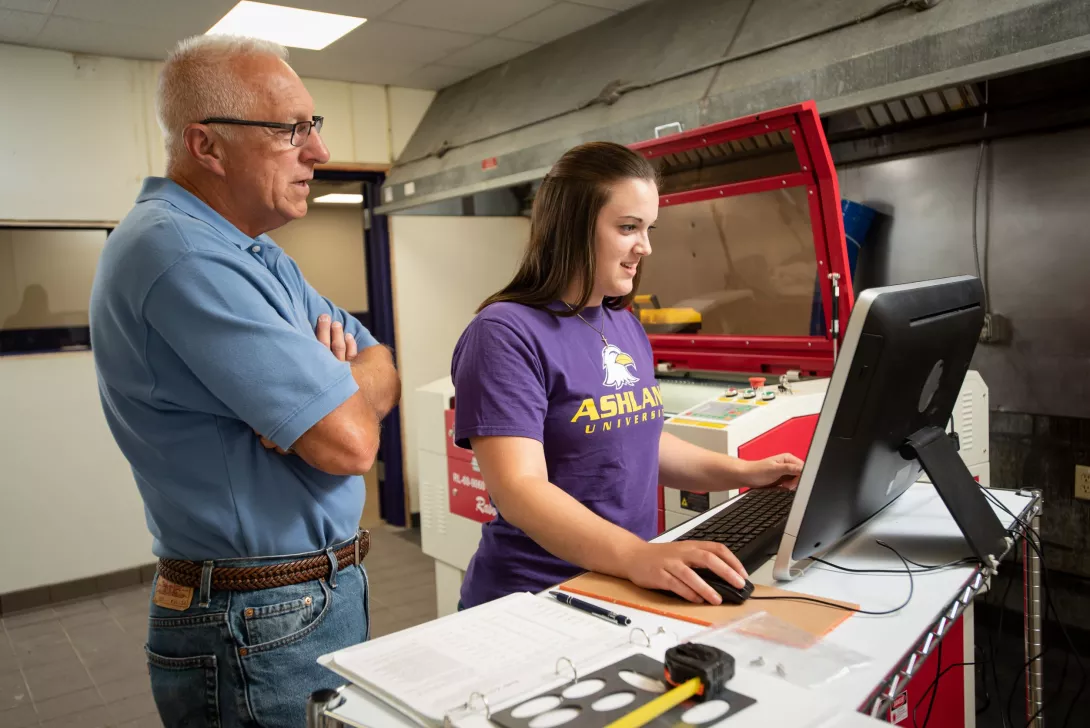
In my Ashland University classroom, I focus on the most critical component of the AI conversation that we can study and apply to better manage in today’s workplaces.
How to think critically to ensure that good work is being produced by the AI systems that are increasingly used in workplaces today. Those are not simply AI skills. They are management skills.

The Future Manager Doesn't Need to Be an AI Engineer
Organizations do not need every manager to become a machine-learning engineer. They need managers who understand well their business, discipline and responsibilities and can recognize when an AI-generated answer is not good enough. It will be the future manager who is able to understand the increasing functionality of many AI systems, understand his/her own business, discipline and job responsibilities, recognize when an AI-generated answer is not good enough, ask better questions and challenge answers. Most importantly, the future manager must understand what constitutes good work, verify information and use human judgment as necessary.
The AI skills gap is real. We may simply be looking for it in the wrong place. When we look for this gap.
Tamika Fair, MBA, DBA, is an adjunct professor at Ashland University's College of Business and Economics and currently teaches MBA courses in business analytics and managerial finance and economics in the health care industry.