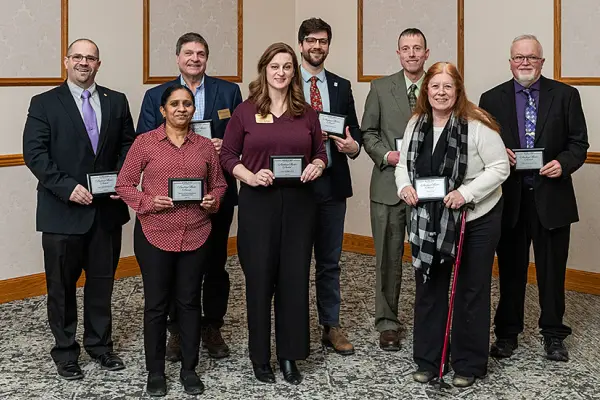
Eight faculty/staff members recognized with Academic Mentor Awards
ASHLAND, Ohio – Eight Ashland University faculty and staff members were honored during the 2026 Academic Mentor Awards ceremony held at the John C. Myers Convocation Center Jan. 30. The annual program recognizes AU mentors who significantly affect a student’s life beyond the classroom by serving as a role model, trusted advisor and guide.
This year’s Academic Mentor Awards went to Diane Bonfiglio, Ph.D., professor of psychology; Adam Crosby, site coordinator of Elayn Hunt Correctional Center in St. Gabriel, La.; Daniel Fox, associate professor of law; Joseph Griffith, Ph.D., assistant professor of history and political science; Lance Kaltenbaugh, associate professor of sport management; Daniel Rickett, Ph.D., adjunct instructor of Biblical studies; Selvanayaki Kolandapalayam Shanmugam, Ph.D., associate professor of computer science; and Jeffrey Weidenhamer, Ph.D., Trustees Distinguished Professor of Chemistry.
Bonfiglio, who also serves as the president of Faculty Senate and assistant director of the Honors Program, has been a faculty member at her alma mater since 2009. She was nominated for the honor by two students, with seniors Oleksandra Bibik and Hannah McCrea each praising her for extraordinary support both academically and personally. In reference to her senior thesis, Bibik noted Bonfiglio’s “patience, professionalism and willingness to spend countless honors listening to my ideas,” and as a student from Ukraine, she felt “seen, heard and cared for” as Bonfiglio regularly reached out to check on her. McCrea described her as an “academic mom” who has been a “vital source of guidance and encouragement” during her thesis work while also offering “some tools that I could use to navigate difficult times.”
Crosby is in his seventh year serving AU’s Correctional Education program at the second-largest prison in Louisiana, located near Baton Rouge, and this marks the second year in a row he has earned a Mentor Award. He was nominated by Paul Gauthreaux and Dustin Carl McClelland, both citing his belief in them, commitment to them and constant encouragement. Gauthreaux wrote about his dedication and teaching him “what it means to be a professional, to give everything … our best shot and to really care about, and take complete control, of our lives and our futures.” McClelland referenced Crosby’s steady support, “having been there with me every step of the way,” and influence on his development, from helping “with research for the various topics and classes that we were in” to “complete and total commitment to seeing us succeed.”
Fox has been a member of the AU faculty since 2004 and served as dean of the Dauch College of Business and Economics for two years. He was nominated by two MBA students – Samgraham Christian and Aashish Tamang. Christian appreciated the “knowledge and wisdom he imparted both inside and outside the classroom,” as well as his “willingness to share industry experience … (which) greatly enriched my education and equipped me with the skills and confidence needed to succeed in the real business world.” To Tamang, Fox’s “passion for entrepreneurship and student development truly stood out” and his “emphasis on thinking outside the box helped (him) better understand complex business problems and develop more creative, viable solutions, skills that have consistently benefited (him).”
Griffith, an AU alumnus and former Ashbrook Scholar, joined the AU faculty in 2023. He was nominated by senior philosophy and political science major Teresa Overholser, who has been impacted by his “mentorship in countless ways.” By teaching “in a way that is deeply engaging and student-centered,” Overholser says that Griffith helped her “become a better reader of books and more thoughtful writer.” On a personal level, he has demonstrated to her “what it looks like to live a life of the mind that is joyful and faithful … and what it means to be rooted in community.”
Kaltenbaugh, currently serving as interim dean of the Dauch College of Business and Economics in addition to his professor duties, has been an AU faculty member since 2000. Senior marketing and sport management major Kale Miller nominated Kaltenbaugh for his “deep commitment to the success of his students … and true mentorship, grounded in mutual respect, honest guidance and a shared vision for personal and professional growth.” Miller is thankful for Kaltenbaugh’s guidance in preparing “for life beyond graduation by cultivating a personal brand,” and personally, “approaching challenges with a growth mindset.”
Rickett is a site director at the Richland Correctional Institution in Mansfield. Todd Cleavenger nominated him for being “a lifeline of advice, counsel … encouragement throughout (his) time” there. Rickett’s compassion for all AU students and humility stood out to Cleavenger, noting that he “treated everyone as an equal … not the norm in a prison setting.” As a professor, Rickett welcomed “one-on-one discussions about the bible that really piqued (Cleavenger’s) interest in the vast knowledge he possessed about ethics, morals and morality.”
Shanmugam has been a member of the AU computer science faculty since 2021. Aniket Patel, a senior computer science major, nominated Shanmugam for helping transform him from a "hesitant transfer student into a confident researcher ready to pursue a future in AI and machine learning.” Patel said she encouraged him to do a presentation at a conference, advice that allowed him “to discover a love for self-directed exploration and deepened (his) skills.” Her encouragement motivated him outside the classroom too, learning “to persist through difficulties and to think of obstacles as opportunities for growth.”
Weidenhamer, the current director of the Honors Program, has been an AU faculty member for more than 35 years. Senior chemistry major Sydney Vu nominated him for constantly “pushing her to be a better students and a better person.” She gained academic confidence when he encouraged her “to run several different scientific machines independently, taught (her) how to design experimental procedures and helped (her) develop writing skills for reports, applications and academic articles.” On a personal level, he was always available for Vu, even “praying for me and my family when I was going through hard times.”
The award-winning mentors were each presented with an engraved silver plate. Nominations were submitted by students via one-page essays and selections were made by the members of the Academic Affairs Committee of the Board of Trustees. The AU Academic Mentor Award was first established in 1986.