New lab provides criminal justice students opportunity to process simulated crime scenes
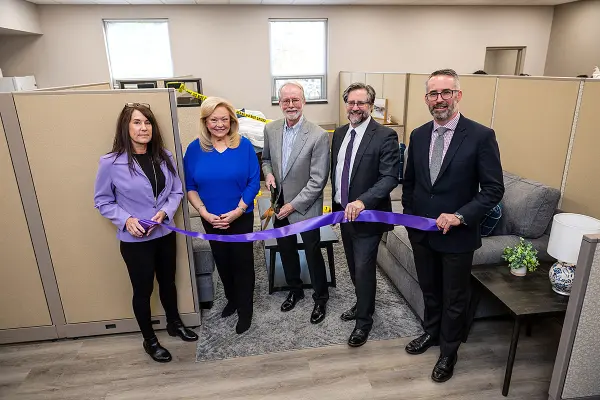
ASHLAND, Ohio – Criminal justice students at Ashland University now have the ability to process a simulated crime scene without stepping out of their classroom, all thanks to a new state-of-the-art crime scene lab that was recently unveiled.
“This is a big deal,” remarked Greg McBrayer, Ph.D., provost at AU, during the ribbon-cutting ceremony. “This facility is impressive and it will enable our impressive faculty members … to simulate real-life experiences that will better prepare students for careers in law enforcement.”
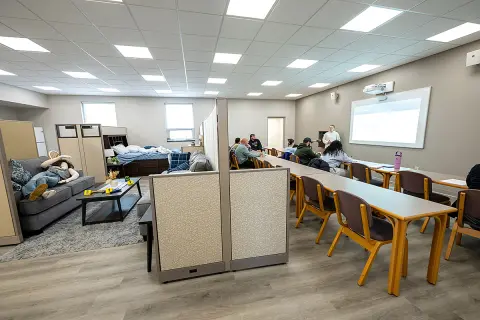
The crime scene lab is the result of a floor-to-ceiling project renovation in an area of Kates that had been neglected. Now, it is a large classroom including a set of wide rows of chairs and desks, enough to seat 25 comfortably, and a whiteboard for “traditional” teaching. But, behind a partition wall is where the excitement lies.
AU’s maintenance team not only modernized the room, but it assembled four distinct areas—a bedroom, bathroom, kitchen and living room—to mimic a one-bedroom apartment. It includes many of the amenities of a typical living space. For example, there is not only a bed and dresser, but bedding, pillows, nightstands, an area rug and decorations in the bedroom, which allows the faculty members to set up realistic domestic violence incidents, natural death scenes and everything in between.
“It’s unlimited what type of crime scenes can be here,” remarked Anne Strouth, director of the criminal justice and emergency management & homeland security programs at AU. “There’s so many different places to hide evidence, so students really have to learn how to properly search.”
There is also more than $20,000 worth of evidence supplies, ranging from manikins, magnifiers and microscopes to kits for DNA evidence, magnetic fingerprints, wound simulations, tire and shoe print casting and much more.

These hands-on crime scene investigations will allow students to develop critical thinking, problem solving and investigative skills that are essential to successful careers in criminal justice.
“What we’re trying to do in this room is somehow marry everything you’re learning from sociology to psychology … to forensic science (and) help make evidence-based decisions, not to give in to assumptions,” Dr. Jon Parrish Peede, president of AU, told students during the official unveiling.
Gaining real-world experience to complement the theory is important for all academic programs, but it is of the utmost importance to criminal justice, according to Strouth.
“I understand theory … and the traditional-type teaching, but in our field, it’s different. You have to be able to do it to effectively measure that the students are learning. So, this is a great environment to see what they can do,” she explained. “They were not able to get this experience previously, not to this extent.”
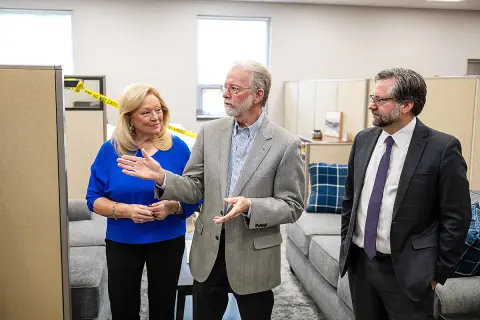
The crime scene room and evidence supplies were all made possible by a gift from Jim and Barb Chandler, whose youngest son Jeffrey Chandler ‘10 graduated from AU. The Chandlers’ reasoning for their generosity was quite simple. It was an opportunity to make a difference for students interested in a career field that will always be needed.
“Unfortunately, crime is not going to go away anytime soon,” explained Jim Chandler. “That’s what clinched it for us – students getting real-world experience. You’re going to be employable the instant you graduate. We’re very excited to be a part of this and very humbled.”
And, once the Chandlers met Strouth, they became even more confident the project would be a success. Strouth is not only a faculty member at AU, but she has more than 30 years of experience in law enforcement and she also currently serves as the director of the Ashland County Emergency Management Agency.
“We felt this is a great little project … makes a lot of sense for us. Then, we talked to Anne and felt so strongly about her and her qualifications, it gave us a great comfort level,” Jim Chandler said. “It’s a great program and the lab was needed.”
McBrayer offered praise to Strouth as well, noting the program’s recent growth directly correlates with her arrival. “Professor Strouth has been here since 2022, and in that time, the criminal justice program has really taken off as a result of her energy, her commitment, her seriousness and her own real-world experience,” he said.
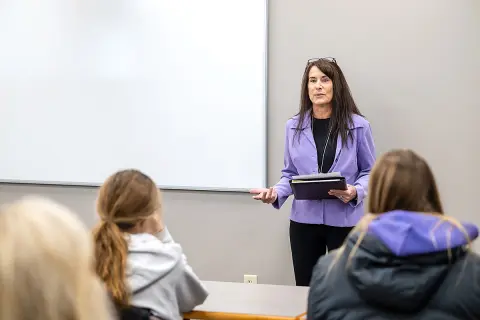
Ultimately, the lab will benefit society, as talented AU criminal justice students will be better prepared to make an immediate impact as public servants. Currently, more than 70% of the program’s graduates enter directly into the field, while 26% go on to law school or graduate school.
“We would be doing a disservice to our community by sending our graduates out there (without) providing them (these) skills. This (lab) really will provide them the confidence that they know they have (the ability) … because they got to do it and see the end result of it,” said Strouth.
Peede added his admiration for AU students who are soon-to-be public servants, saying that “this idea of evidence-based decision making, forensic knowledge and what it can be at its best … gets us toward the truth. So, that’s an awesome responsibility.”
One final note: the lab will be useful for academic programs outside of criminal justice. Faculty and students in forensic chemistry and forensic biology, as well as social work, are planning to use the lab as well. And, the Ashbrook Academy summer program for high school students annually includes a CSI session.