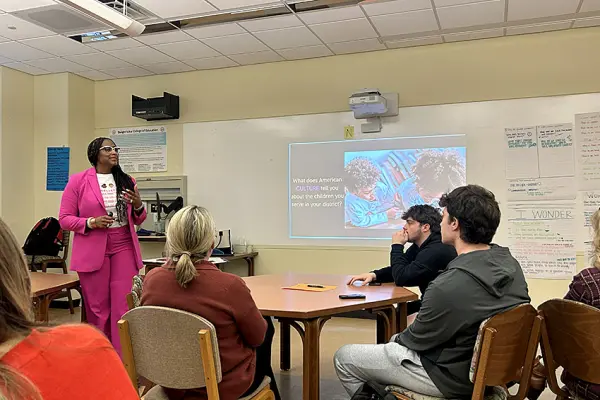
Ashland University, Columbus City Schools partnership reshaping educator preparation
ASHLAND, Ohio – A five-year partnership between Ashland University’s Dwight Schar College of Education and the Columbus City Schools that began with a goal of strengthening education leaders has evolved into something much wider in scope: a collaborative effort to redesign educator preparation curriculum and new microcredentials in high-demand areas, which will benefit Ashland’s teacher and principal candidates and ultimately PK-12 students.
This extensive partnership was funded through a grant from the Wallace Foundation, specifically its Equity-Centered Principal Pipeline Initiative. It required eight selected urban school districts from across the country to each partner with institutions of higher education to provide high-quality training for future education leaders, and because of a longstanding relationship Columbus City Schools selected Ashland University.
Together, AU and CCS have recruited and supported six cohorts, with 120 educators earning principal licensure through AU’s Educational Leadership program. Those graduates, whose coursework and experiences reflected the Ohio Standards for Principals, now serve across the CCS district as teacher leaders, leadership interns, assistant principals and other emerging leadership roles.
“Research continues to show that school leaders play a critical role alongside classroom teachers in student success. This makes the intentional development of strong school leaders essential,” said Mickie Sebenoler, Ph.D., the project director of the Columbus City Schools Principal Pipeline Initiative and herself a proud 1991 graduate of AU. “What makes this partnership so powerful is the educator network it creates through learning together, working through real challenges in urban education and moving toward the same goal of personal and professional growth.”
One of the strengths of the partnership, according to Sebenoler, has been the authentic and deep connection formed between the two groups as they connected coursework to practice. Internships were designed for CCS leadership experiences, allowing candidates to apply their learning while receiving support from both university faculty and district mentors.
The partnership didn’t stop with principal preparation. As it evolved naturally, AU listened to and leaned on the CCS practicing educators—district administrators, principals, assistant principals, teachers and program graduates—to rethink how it prepares educators at multiple levels, especially over a five-month period during this past year when they took on a curriculum revision and microcredentialing project, guided by Christy Becknell-Brown, assistant dean of the Dwight Schar College of Education.
“Our Columbus City partners brought a truly valuable practitioner lens to the revision process of several of our programs, as well as the microcredentialing project across six programs,” said Becknell-Brown.
Key stakeholders from both AU and CCS reviewed, revised and modernized education preparation programs across AU’s undergraduate, graduate, endorsement and licensure pathways. The project intentionally utilized the expertise of current practitioners to ensure coursework reflected the realities, challenges and expectations of today’s schools, and the result is a more current, relevant and practice-centered educator preparation curriculum, along with a suite of innovative microcredentials that expand professional learning opportunities for both aspiring and practicing educators.
“The mutual benefit between our faculty and our partners at Columbus City Schools (has been) truly remarkable,” Becknell-Brown explained. “Our university faculty are accustomed to preparing teachers to teach and principals to lead. Yet one of the most powerful lessons from this partnership was recognizing just how much we had to learn from the practitioners doing this work every day. There was something both humbling and beautifully reciprocal about that exchange of expertise. Our faculty came away energized and deeply appreciative.”
From Sebenoler’s perspective, the curriculum revision and microcredentialing project aligns succinctly with the Principal Pipeline Initiative. “Great school leadership starts with great teaching. Educators are always learning because students’ needs and our world around them keeps changing. Professional learning should be thoughtful and relevant, helping teachers and principals advance their thinking and their practice to bring their best to every student,” she said.
The AU and CCS partnership has been such a success, the Wallace Foundation recently extended the grant for a sixth year. Not only will principal licensure candidates continue working through the pipeline, but it provides an opportunity for both parties to continue building their relationship and tweaking educator preparation programs together.
“Wallace’s decision to extend funding for an additional year was an unexpected and incredibly meaningful opportunity for us,” said Becknell-Brown. “This gives us the chance to deepen the partnership in ways we had hoped for, but not originally anticipated. It creates opportunities for our faculty and students to engage directly with the Columbus City Schools, learning alongside practitioners, working with families and communities and experiencing firsthand what authentic family engagement looks like in practice.”
She continued, “This is especially significant as we continue to strengthen our alignment with CAEP (Council for the Accreditation of Educator Preparation) standards and prepare educators who understand that meaningful engagement extends well beyond the classroom. These field-based experiences can be difficult to create within traditional educator preparation programs, so having the opportunity to immerse our students in this work is both professionally valuable and deeply important to their development as future educators and leaders.”
About the Wallace Foundation
Wallace is an independent, nonpartisan research foundation with a mission to help all communities build a more vibrant and just future by fostering advances in the arts, education leadership and youth development. Through collaborations with grantees and research partners to design and test innovative approaches to address pressing problems in the fields it serves. The evidence-based insights support policymakers and practitioners in their efforts to improve outcomes, enhance community vitality and help all people reach their full potential.