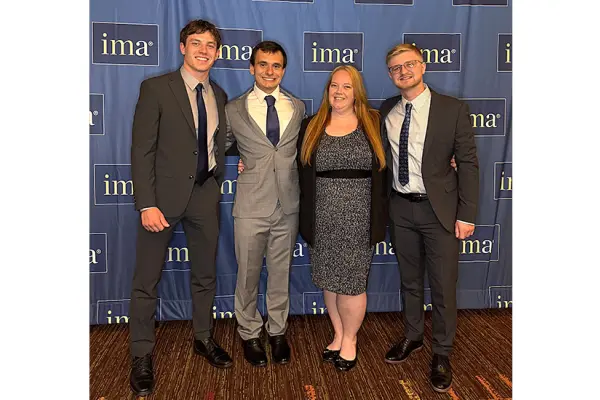
Team of AU students one of four finalists in national IMA case study competition
ASHLAND, Ohio – NBA teams seeking new executives in business analytics may come calling Ashland University graduates soon after a team of AU students—Josh Hagan, Dymtro Solomianiuk, Max Vesper and Hilary Wallace—finished as one of four finalists in a national case study competition.
The AU group, along with the other three finalists, presented its findings from the case, “NBA Player Acquisition: Cost-Benefits Analysis & Visualizations,” earlier this summer at the Institute for Management Accountants (IMA) Accounting and Finance Conference in Scottsdale, Arizona. The IMA sponsors the annual student case competition to provide an opportunity for students to interpret, analyze, evaluate, synthesize and communicate a solution to a management accounting problem.
“It’s a big deal,” remarked Timothy Hinkel, Ph.D., chair of the department of accounting and management information systems. “The fact that we had AU compete on a national stage speaks to the quality of our programs, the talents of our students and they’re willingness to challenge themselves.”
Long before the IMA conference presentation, Wallace recruited some of her fellow members of Ashland’s IMA chapter to form a team of two undergraduate students and two graduate students per the competition’s rules. Solomianiuk and Vesper, both studying business analytics and finance, are on track to graduate with bachelor’s degrees next May, while Hagan and Wallace each completed the M.S. in Business Analytics program this spring.
The months-long project, which took place outside of regular classwork, tasked each participating group to select an NBA franchise—AU’s team chose the Minnesota Timberwolves—then efficiently use resources to recommend 1-to-3 free agents that would improve its win total and championship potential while also fitting within the league’s salary cap.
Hagan, Solomianiuk, Vesper and Wallace, which named themselves Courtside Consulting, put on their collective general manager hat and went to work, evaluating the available data and metrics, identifying the most important variables and developing creative solutions. After some initial collaboration, they decided it would be of utmost importance to construct algorithms to eliminate any bias in their decision making.
“We started with a mathematical model to assess (which) performance statistics, such as offensive rebounds and effective field-goal percentage, are the best predictors of a teams’ win-loss percentage over a given year,” explained Hagan, originally from Springboro, Ohio, near Dayton. “Then, we plugged into our model three players based on gaps in Minnesota’s roster, essentially the three combinations of players who were below the median salary for each position, which is going to get the highest win-loss percentage.”
“What they wound up doing was pretty exotic,” agreed Hinkel. “They really got sophisticated with their modeling.”
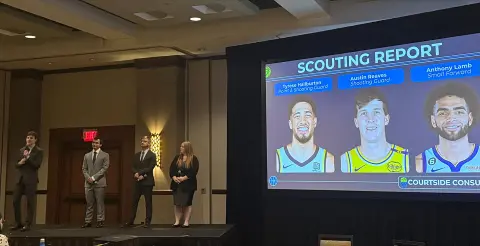
Once, Courtside Consulting found out it was selected as a finalist among the 40 or so entrants, it was time to focus on the data visualization and presentation aspect of the project, which admittedly put the team out of its comfort zone. They practiced two or three nights a week for a couple hours each night during the month of May and into June.
“The prep just pushed us further and further,” said Wallace. “There’s no right or wrong solution. That’s the beauty of these case studies. (You) just have to prove why what you decided is the best solution.”
While the final vote didn’t go its way, the AU team unanimously agreed that the presentation and overall experience were ultimately a success. From the first days forming Courtside Consulting to the all-expense-paid trip to Arizona and everything in between, all four students were grateful to have taken part in the résumé-building project.
For Hagan, the real-world data analytics project confirmed his passion for analytics and reinforced what he was already learning in the classroom. “I didn’t realize when I started out on this case how applicable our classwork was to some of the stuff we would implement … and how I was going to ingrain these skills in my future career development,” he said.
Vesper, who went to Hillsdale High School just outside of Ashland, was appreciative of the formal presentation and the professional conference itself, both firsts for him. “I just learned a lot from the presentation part of it … it was great to get some experience in that. Then, also the conference was really good for networking. It was really cool to see where the industry is at,” he said.
For Wallace, it marked the culmination of her Ashland journey (she also earned a bachelor’s degree in accounting and business law from AU) and her meaningful time leading the IMA chapter. “Allowing our students (this) opportunity has really changed my life and opened my eyes to what is possible,” she said. “Case studies and competitions like this really help give us that real-world experience … working as a team, learning how to manage different personalities … (and) solving this problem.”
Solomianiuk, a member of AU’s Ukrainian Freedom Scholars program, found inspiration in attending the conference and thinks all AU students should take advantage of similar opportunities. “Such events help you see the world and what people do,” he reflected. “You know this curriculum, this material and you start talking to people at this conference, and (think) they pay you money for it, that’s kind of cool.”
And, from Hinkel’s perspective, the benefits were two-fold. “The value, to me, comes from a couple of different places,” he observed. “First, it’s one thing to perform a case study or do an assignment for a professor who you know, but this is a competition. You’re going to have to make decisions. You’re going to have to present. It’s going to be uncomfortable … taking that application to a real-world scenario when the stakes are high.”
He continued, “This is not something the students had to do. They opted into it. They self-selected, saying ‘you know what, I’m going to go above and beyond and I’m going to challenge myself and this group to this case study.’ That’s another layer of value, doing something hard and uncomfortable.”
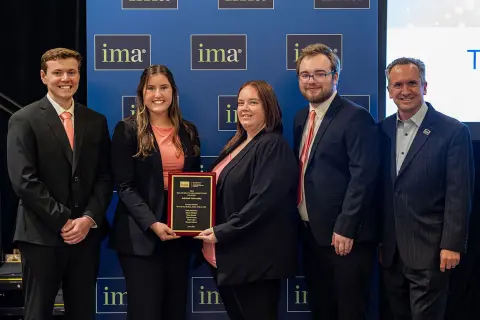
This actually marked the second consecutive year a team of AU students was a finalist in the IMA student case competition. Last year, Wallace was joined by Ryan Baxter, Haven Farson, Drew Lind and Hunter Schuck for a case comparing the fair value and equity methods for stock investments, “Determining How to Classify Stock Investments: The Case of Unbekannt, Inc.”
Hinkel called AU’s back-to-back finalist showings in the national case study competition “pretty incredible,” and credited faculty members Paul Holmes, Ph.D., Nikita Lopatin, Ph.D., and Sue Mullen, MBA, for their efforts.
“Business analytics is a relatively new program at our school,” he explained. “The fact that … those students are getting a high enough quality of education that they’re able to compete at a national level speaks to the faculty that developed those programs and offer those classes.”
While the members of Courtside Consulting haven’t heard from any NBA teams yet, the master’s graduates are taking the lessons they learned on new adventures. Wallace, who grew up in Millersburg, Ohio, is moving on to pursue a Ph.D. in accounting at the University of Kansas, and Hagan will start a career as a data scientist.
That leaves Solomianiuk, Vesper and others to carry on this new AU tradition of qualifying for the IMA national case study competition.